Flexible Deployment Architecture

Run Control where your infrastructure lives.

On premises, in a private data center, or in a public cloud, Control runs as a clearly structured container stack and remains close to the network, the evidence, and existing operating processes.

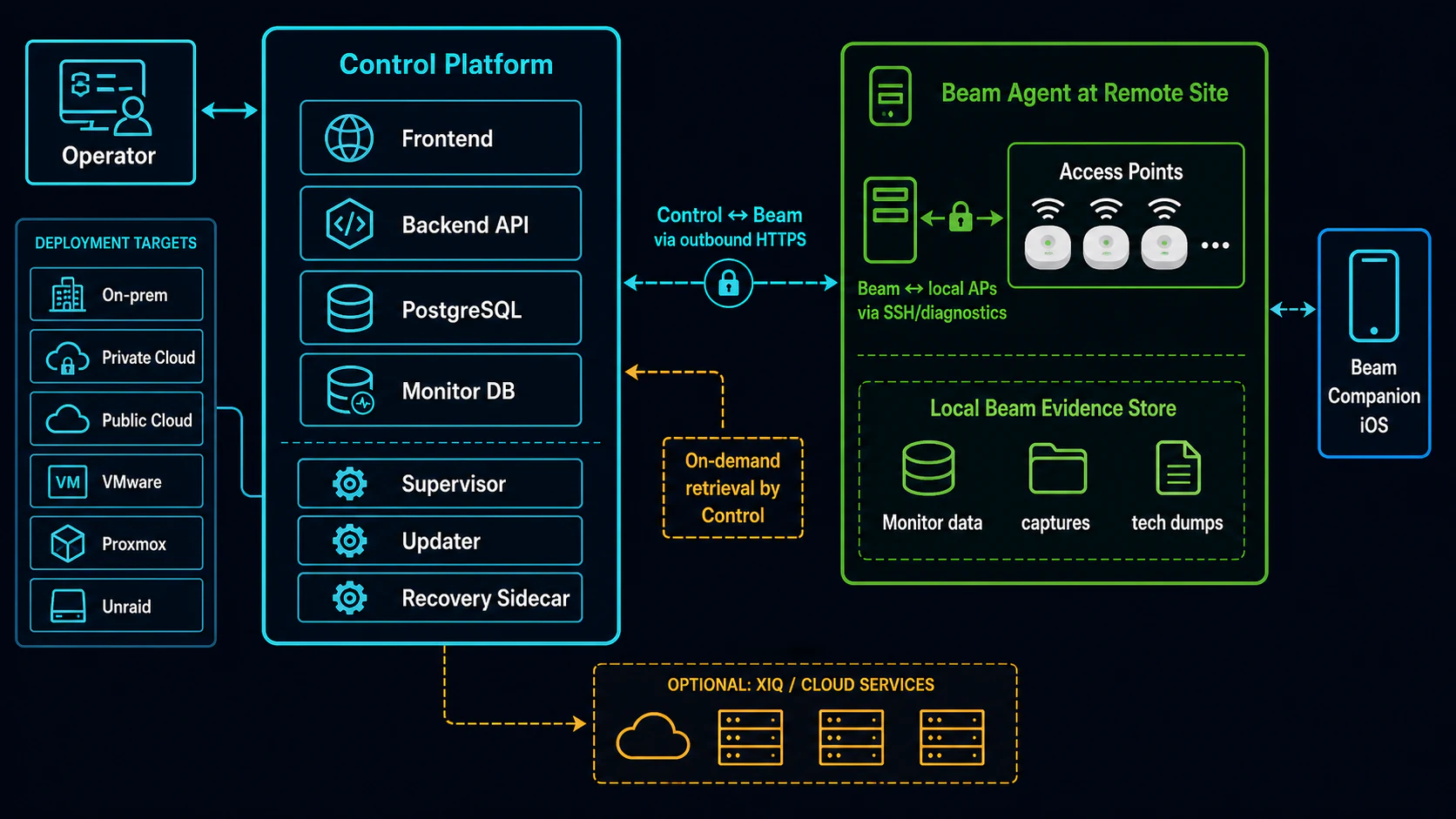
Control deployment architecture with core, Beam, Companion, updates, and recovery
On premises, private cloud, or public cloud · central core · local execution with Beam

Deployment targets

One platform model. Multiple operating environments.

A guided installation path for Ubuntu LTS covers networking, storage, roles, and operational parameters.

ON-PREMISES

Dedicated servers and appliances

Control stays close to network segments, operators, and established operating processes.

VIRTUALIZATION

VMware, Hyper-V, Proxmox, and KVM

Suitable for traditional virtualization as well as streamlined Linux and container platforms.

CLOUD

AWS, Azure, and private cloud

The core can run in the cloud while Beam handles local execution at remote sites.

UNRAID / DOCKER

Standardized container foundation

Clear components, traceable storage paths, and controlled operations.

Core stack

Clear components. Clear responsibilities.

  • Control frontend and backend API
  • PostgreSQL
  • Monitor / Timescale data store
  • Supervisor and updater
  • Recovery Sidecar
  • optional Beam Agents for remote sites
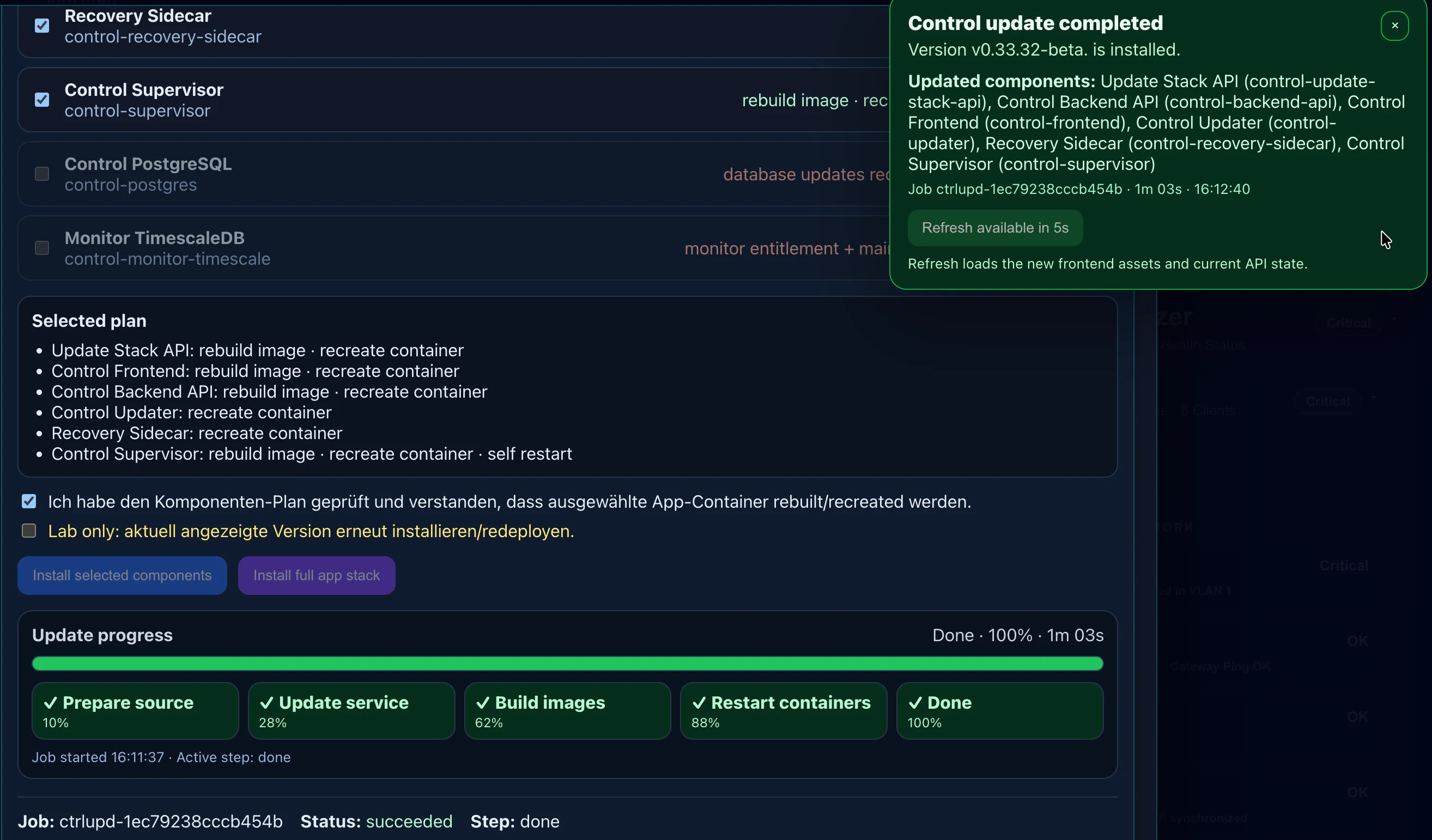
Control update with component plan, progress, and completion status
Supervisor-controlled update plan with build, restart, and completion status.
UPDATES

Update without losing operational state.

The supervisor coordinates the update plan, build, restart, and completion status. Databases, storage, and operational artifacts are handled separately.

RECOVERY

Automated and manual recovery paths.

Health checks, the supervisor, and the recovery sidecar support service restoration. Manual recovery and restore workflows provide additional operational control.

LOGGING

Every technical operation remains traceable.

Platform queries, service checks, reports, captures, tech dumps, Beam jobs, updates, backups, recovery actions, and internal health events are logged.

System requirements

Planning basis for Control and Beam.

This compact overview lists sizing tiers, AP and client volumes, complete retention periods, and CPU, RAM and storage requirements for Control and Beam.

PDF · German / English

Download system requirements

All values on two clear pages—in German and English—for planning, proposals, and technical alignment.

  • Sizing tiers S, M, L and XL
  • AP and client guidelines per sizing tier
  • Retention periods for monitoring, captures, and tech dumps
  • CPU, RAM, system SSD, and data SSD

Concrete planning examples

Three concrete architectures—regional, multi-regional, and global.

All examples are designed for 90 days of full monitoring. They show practical VMware ESXi layouts and serve as a concrete basis for planning.

EXAMPLE S · REGIONAL

Asia-Pacific—compact and deliberately simple

A regional setup with a redundant Control core and one Beam Agent located directly in Asia-Pacific.

Scale
1,000 APs · 5,000 clients
Retention
90 days of full monitoring
Control
2 × Control S on VMware ESXi
Beam
1 × Beam Agent in Asia-Pacific on VMware ESXi
Redundancy
Control redundant · Beam non-redundant
Total
3 VMs
Control VM4 vCPU · 12 GB RAM · 256 GB system SSD · 1 TB data SSD
Beam VM2 vCPU · 4 GB RAM · 128 GB SSD
EXAMPLE M · MULTI-REGION

Germany as the core—with local execution in North America and Asia-Pacific

The redundant Control core runs in Germany. One redundant Beam pair handles local execution in North America and another in Asia-Pacific.

Scale
3,500 APs · 15,000 clients
Retention
90 days of full monitoring
Control
2 × Control M in Germany on VMware ESXi
Beam
2 × Beam Agents in North America and 2 × Beam Agents in Asia-Pacific, all on VMware ESXi
Redundancy
Control and both Beam regions redundant
Total
6 VMs
Control VM8 vCPU · 24 GB RAM · 256 GB system SSD · 2 TB data SSD
Beam VM2 vCPU · 4 GB RAM · 128 GB SSD
EXAMPLE XL · GLOBAL

Global operations with three redundant Beam regions

The redundant Control core is complemented by one Beam pair in South America, North America, and Asia-Pacific.

Scale
15,000 APs · 75,000 clients
Retention
90 days of full monitoring
Control
2 × Control XL on VMware ESXi
Beam
2 × Beam Agents in each of South America, North America, and Asia-Pacific on VMware ESXi
Redundancy
Control and all three Beam regions redundant
Total
8 VMs
Control VM16 vCPU · 64 GB RAM · 512 GB system SSD · 8 TB data SSD
Beam VM2 vCPU · 4 GB RAM · 128 GB SSD

Remote architecture

Central core. Local execution with Beam.

Access points can be investigated directly by Control or through Beam at the remote site. Beam stores captures, tech dumps, diagnostic data, and monitor data locally and makes them available centrally on demand. Beam Companion connects mobile field work with Control.